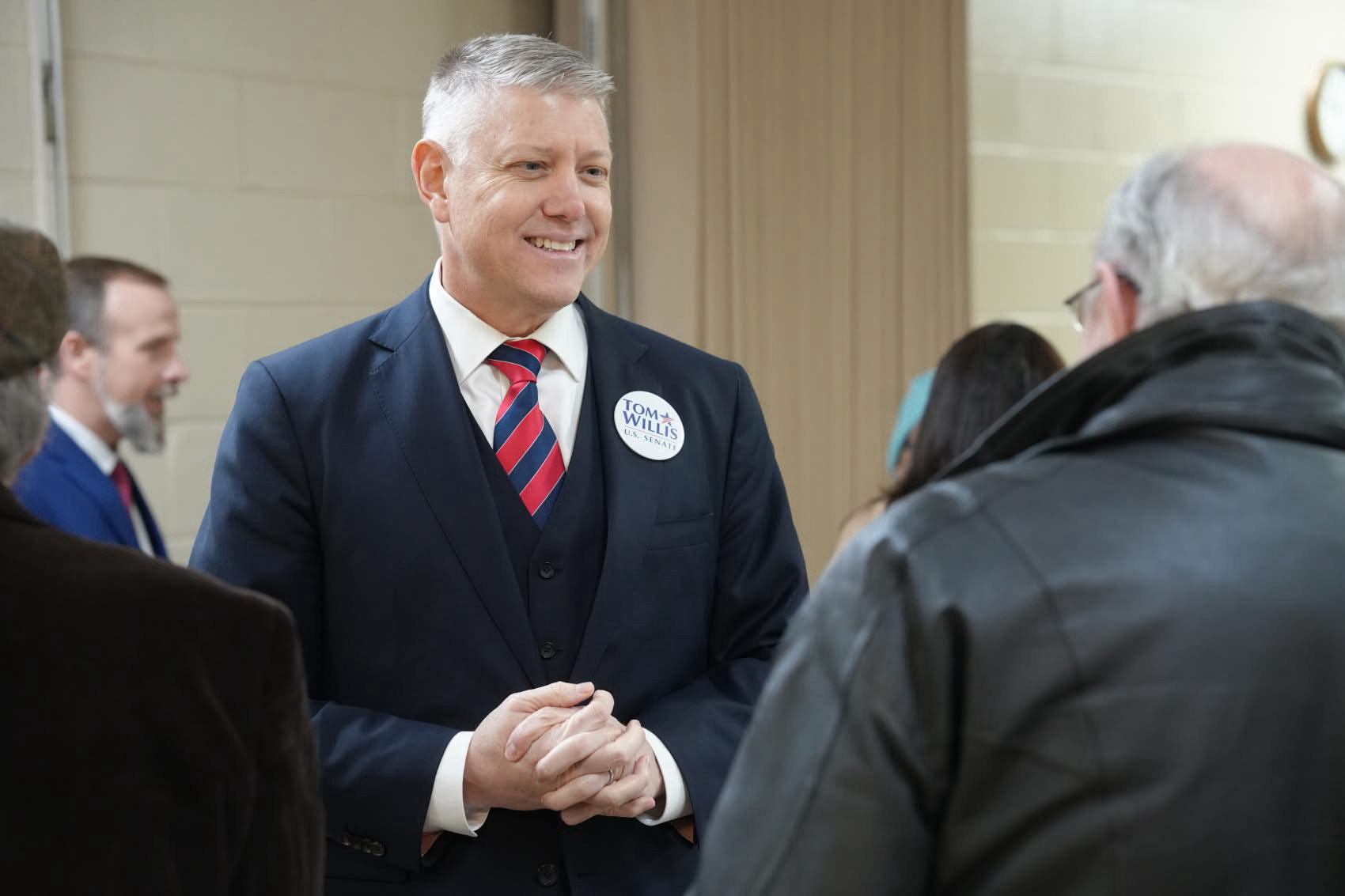
Many have tried — and failed — to take on Sen. Shelley Moore Capito (R-W.Va.) over the course of her career on Capitol Hill, but state senator Tom Willis believes the tides are turning in his favor just a week out from the May 12 primary.
Wills, taking a break from canvassing and speaking from his truck in Capito’s home turf of Charleston on April 29, wasn’t shy about his criticisms of the longtime incumbent and leader of her family’s political dynasty, leveraging that she’s strayed from what he considers a necessary path and aligned herself with whichever tide is strongest at any given moment.
“[She’s] strayed away from what we would consider West Virginia traditional family values,” he said. “I’m offering voters a conservative option. … She has an ‘F’ rating for conservative voting, and that’s not coming from Tom Willis; it’s coming from CPAC, Heritage Action, Freedom Works, these national rating agencies. On the other hand, I have a 100% conservative voting record for Make Liberty Win.”
While The Spirit could not independently verify Make Liberty Win’s voting records, Willis continued to leverage his position against Capito, stating that she has voted in favor of same-sex marriage, funded red flag legislation and that she has been “pro-abortion basically her whole career,” as well as claiming she’s flip-flopped to pro-life for the 2026 election. “But we know that she voted for funding for Planned Parenthood to use taxpayer dollars for abortions,” he added.
Regarding same-sex marriage, Capito voted in 2022 to advance the Respect for Marriage Act, which provided “statutory authority” for same-sex and interracial marriages and effectively repealed the 1996 Defense of Marriage Act (DOMA). At the time, Capito released a statement saying that while constituents had contacted her about their strong beliefs on traditional marriage, she was upholding the principle that those beliefs should be respected and that the bill would not force religious entities to provide support for same-sex marriage. She also said that the bill would allow those married after the 2015 Supreme Court ruling in Obergefell v. Hodges to retain federal benefits.
“This does not lessen the traditional sanctity of marriage or jeopardize the freedom of religious institutions,” her statement read.
Further, Capito’s record on the matter shows that she was against federal action regarding same-sex marriage, saying in 2015 that “while I would have preferred that the Supreme Court leave this decision to the states, it is my hope that all West Virginians will move forward and continue to care for and respect one another.” Nationally, the needle has moved on the matter since the Obergefell decision, with other major players in both parties accepting same-sex marriage as a Constitutional right.
Additionally, Capito’s track record on abortion has largely remained the same. She holds an A-plus rating with Susan B. Anthony Pro-Life America and a zero percent rating with the pro-choice group Reproductive Freedom for All. In recent years, a small selection of abortion-related actions taken by Capito has been:
• Voted in 2015 to prohibit federal funding for Planned Parenthood.
• Voted for the FY 2017 budget reconciliation’s McConnell Amendment that would have defunded Planned Parenthood.
• Voted in 2021 to codify the Hyde Amendment that would have ensured no federal funds could be used for abortions or to subsidize them in healthcare plans.
• Reeled against the Democrat-led S.B. 4132 in 2022 before the Supreme Court’s Dobbs v. Jackson Women’s Health Organization decision that overturned Roe v. Wade.
• Said of the Dobb’s decision that, “the Supreme Court has returned this issue to the states to make their own determination. I support this decision, and I would expect West Virginia to support this decision as well.”
• And supported the 2024 Senate Bill "Allowing Greater Access to Safe and Effective Contraception Act," a counter to Sen. Chuck Schumer’s (D-N.Y.) “partisan and extreme legislation designed to mislead and invoke fear.”
Lastly, regarding “red flag laws,” Capito did vote in support of the Bipartisan Safer Communities Act of 2022 — a bill brought forth by then-senator and current U.S. Secretary of State Marco Rubio — which expanded background check requirements, broadened existing restrictions and established new criminal offenses, according to the bill. It also provided funding for mental and behavioral services, enhanced security initiatives in schools and addressed gun violence in communities. To note, since then, there has been no significant rise in law enforcement enacting extreme-risk protection orders (ERPOs) through red flag laws or abridging legal gun owners’ rights. And, at the time of the bill's passing, Capito was clear that her position was that West Virginia would “never be a red flag law state.”
Taking on the head of the dynasty
Still, Willis was clear that a central factor in his choice to run against Capito is based on her time in office. To him, it’s simply time for a change.
“I think West Virginians are just kind of sick and tired of it,” he said. “It’s showing, and she’s not fighting for West Virginians. She’s serving herself.”
Willis claims that Capito is ranked as “one of the two or three insider traders in the U.S. Senate,” citing “organizations that rank insider trading in the U.S. Congress" as his source of information, but there is no factual evidence to support this, as insider trading is illegal and no legal action has been taken against the senator.
Capito’s trades are public, however. According to Quiver Quantitative, an online data provider, Capito has made 578 total trades since her Senate election in 2015, with her last trade on March 31 — a sale of stocks in FDS between $1,001 and $15,000. The platform also estimates that her net worth is $4.88 million and her trade volume is $5.66 million.
Another criticism is that Capito “fought to have her son [Moore Capito] appointed as the U.S. Attorney for the Southern District, which went through in 2025 with a host of other appointments. Willis took issue with her voting for that appointment. At the time, it was reported by Mountain State Spotlight that Capito’s spokesperson, Kelley Moore, said that “the ethics are clear on this vote," brushing off any such criticism that she should have recused herself.
MSS further reported that the ethical issue was raised by the West Virginia Democratic Party, saying that her vote on President Donald Trump’s “Big Beautiful Bill” was essentially a quid pro quo for Moore Capito’s nomination, but that Senate rules “do not prevent a member from confirming a relative to an appointed position," but "it does prohibit them from using their office to help a relative achieve financial gain.”
Regardless, Willis stuck to the public eye approach.
“Across the state, folks are telling me it’s time for change. And I’m offering voters a conservative option for U.S. Senate,” he said.
A two-player race?
When asked about concerns of a dense primary, Willis wasn't too concerned about the other candidates, suggesting the Republican choice is ultimately between him and Capito.
In total, there are four other candidates in the primary: Alexander Gasserud, Bryan McKinney, Janet McNulty and David Purkey. Of the four, Purkey is the only candidate without previous races on his resume; the other three have all lost by wide margins in their respective primaries.
“None of them have any sort of resume or accomplishment,” Willis said of the four. “I think one person is a grocery cashier, two are unemployed, one is retired and isn’t working, isn’t campaigning at all. I saw him at just one event in his hometown, but he’s not doing anything.
“It’s a tight race between me and Shelley now. So if voters want a conservative option, if they want to see Shelley go, don’t waste a vote on any [other] candidate. You’ve got to vote for Tom Willis if you want to move Shelley out of office.”
No traditional national or statewide polling data was available at the time of this report to support Willis' claim, but Kalshi, a prediction market, currently has Capito winning the race with a 99.1% likelihood. Willis and the others all have less than a 1% chance, by its metrics. Still, Kalshi is a betting platform and not a vetted voter poll.
Regarding his campaign, Willis said it's constructed on a few pillars. “First and foremost, our Republican platform is what we stand for and it’s to be a non-negotiable — number one, of which, is that God is real,” he said.
He said that voters can always count on him to defend life, Second Amendment freedoms and religious freedoms. Backing up his platform, he touted his endorsements from the West Virginia Citizens Defense League and Gun Owners of America, as well as his A rating from the National Rifle Association. Capito has an A-minus rating. Willis has an A-plus rating with WVCDL, while Capito holds a C rating.
Still, Willis is facing quite a challenge. Capito, despite maintaining a somewhat low profile in Washington and not being fully entrenched in the MAGA movement, has the full support of President Trump, as well as Vice President J.D. Vance and a litany of elected officials in both D.C. and West Virginia.
Lastly, she has serious backing from different PACS, including Big “I” WV, the Gas and Oil Association of West Virginia, U.S. Chamber of Commerce, United Mine Workers of America, the West Virginia Chamber of Commerce and West Virginians for Life, among many others.
Policy points
Willis aspires to hit the ground running on Capitol Hill should he pull the upset and further win in November. He said he would quickly work to set term limits for members of Congress and to “pass a budget every year.” He also said he would add to the current momentum to secure the border.
“President Trump has done a great job, but we can’t always rely on him,” he said of the border. “We’ve got to have other people that can step up and fight that battle as well.”
Unprompted, Willis shared his wife’s legal pathway to becoming a U.S. citizen to support his immigration aspirations. Meeting her in Macedonia, a country in the Balkans, during one of his deployments with the U.S. Army, he remembered an interesting point that the immigration process screens for communism — the political system Macedonia operated under from 1945 to 1991. But, with communism in the rear-view mirror as a high-level threat for many Americans, Willis wants to update the system to screen for Sharia Law.
“Sharia Law is not just a religious system, it’s a political system,” he said. “It’s a legal system, a judicial system, and it's completely antithetical to our Constitutional Republic form of government. So that’s a priority for me.”
He cited Western Europe as a glimpse into the effects of Sharia Law and how it could come to America. And, while informal Sharia councils do exist for Muslim communities in places like the United Kingdom and in private law in Austria and Germany with guardrails, there is no formal Sharia system established on a national level in any Western European country.
And, when pressed about Sharia law being a major threat to the United States, he doubled down on his experiences in the Middle East and Europe.
“It’s hard to understand if you haven’t actually lived there or traveled through Western Europe," he said. "I did an Eagle Scout exchange in Belgium back in the 90s and then I did a semester abroad in France for law school also in the 90s. I saw Europe what it was 30 years ago, then I visited recently.
“It has drastically changed. Walking through a Muslim neighborhood with my son on crutches and my wife and teenage daughter late at night after we were visiting the Montmartre Cathedral, it’s the most fearful I’ve been in my life. And I was a trained Green Beret. The hostility, the looks at the females in my family.
“I would be very careful if you haven’t, if you don’t have the experience with this culture and with this system, I would just caution your readers to be very cautious about passing judgment and talk to some of us in the military that have lived in these countries, served in these countries, seeing how the women are oppressed in these countries.”
He added that moral collapse leading to “our out-of-control national debt” and China are other critical threats to the country.
Lastly, Willis said he’d continue to support infrastructure funding around the state, while also working to lower the cost of living in the state by “reducing the size of the government, cutting regulations and fighting for free market enterprise in all sectors.”
A 'David and Goliath' fight
In less than 10 days, Willis will find out if his campaign has stuck.
He lost his first campaign in 2018 for the U.S. Senate when he took on Patrick Morrisey in the primary, but secured a stunning upset in the 2024 state senate primary over Craig Blair and a deafening win over Democrat Anthony Murray in the general election, pushing him into politics full force.
“It really is a David versus Goliath type race,” he said. “The good news is my last race against the Lieutenant Governor was very similar. You’ve got the one side, Shelley’s side, you have sort of the old money families, the old money business owners. They’ve been around for a long time. You’ve got a lot of the establishment media and establishment D.C. all working against me.
“They’ve tried to cut off our oxygen with fundraising and with media exposure. Those are all the same things I saw in my last race. … But how do you defeat that? Well, you have to go around the traditional media and the establishment to go to the voters and the base. That’s what I’ve been doing. You see me, I’m in my truck right now, pulled over at a gas station. I’ve been hustling all over the state, talking to voters one at a time ... listening to their concerns and needs so I can know how to better serve them.”
Voting for the primary election is on May 12. Early voting is still available through May 9 at the Jefferson County Government Complex at 393 N. Lawrence St. in Charles Town from 9 a.m. to 5 p.m.